
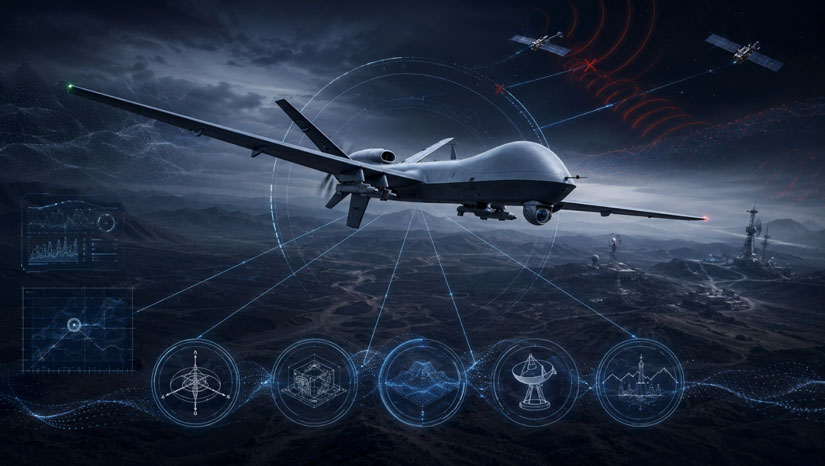
Modern military and critical infrastructure operations depend on accurate Positioning, Navigation, and Timing (PNT) information. For decades, Global Navigation Satellite Systems (GNSS), including GPS, have provided the foundation for navigation and synchronization across land, sea, air, and space.
However, today’s operational environments present new challenges. Electronic warfare, signal interference, spoofing attacks, and increasingly contested electromagnetic environments can significantly reduce the reliability of satellite navigation.
This is where Assured Positioning, Navigation, and Timing (APNT) becomes essential.
APNT refers to a collection of technologies, sensors, and operational strategies that ensure reliable navigation and timing information remains available even when satellite signals are degraded, denied, or intentionally disrupted.
Why Traditional GPS Is No Longer Enough
Although GPS remains one of the most accurate positioning technologies available, it was never designed to be the sole source of navigation for mission-critical operations.
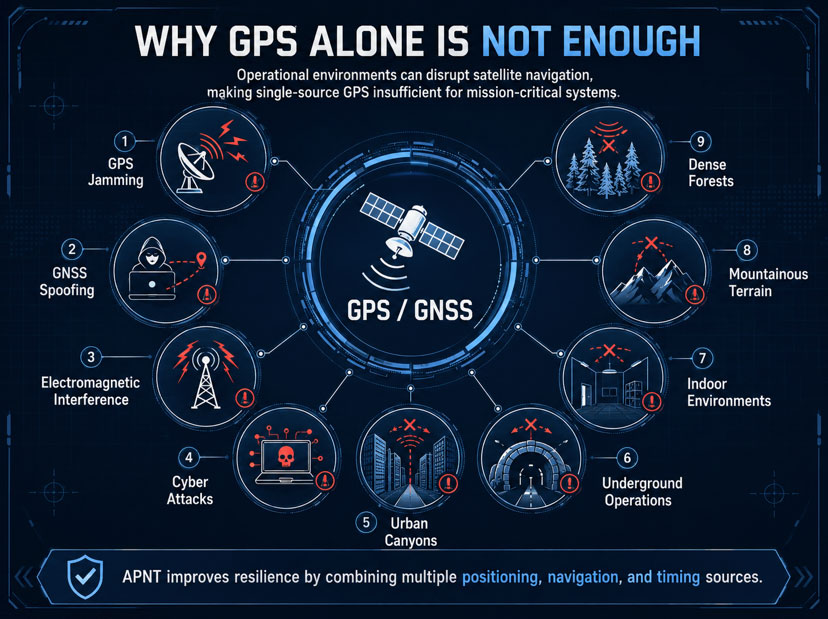
Modern threats include:
- GPS jamming
- GNSS spoofing
- Electromagnetic interference
- Cyber attacks
- Urban canyons
- Underground operations
- Indoor environments
- Mountainous terrain
- Dense forests
In these situations, relying exclusively on satellite navigation may result in reduced operational effectiveness or complete loss of positioning capability.
What Does APNT Include?
Rather than depending on a single navigation source, APNT combines multiple technologies to provide continuous positioning and timing.
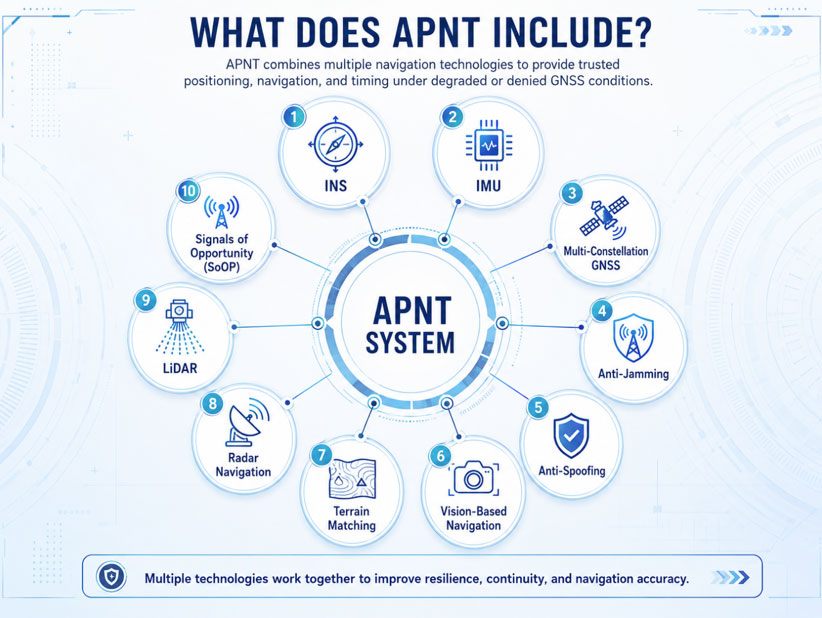
Typical APNT systems integrate:
Inertial Navigation Systems (INS)
INS uses accelerometers and gyroscopes to calculate position, velocity, and orientation without requiring external signals.
Inertial Measurement Units (IMUs)
Modern MEMS, Fiber Optic Gyroscope (FOG), and Ring Laser Gyroscope (RLG) technologies provide highly accurate motion sensing for navigation systems.
Multi-Constellation GNSS
Support for GPS, Galileo, GLONASS, and BeiDou improves availability whenever satellite signals remain accessible.
Anti-Jamming Technology
Specialized antennas and signal processing techniques help maintain GNSS reception in contested electromagnetic environments.
Anti-Spoofing Protection
Advanced algorithms detect manipulated navigation signals and prevent false positioning data from affecting mission systems.
Alternative Navigation Sources
APNT solutions may also incorporate:
- Vision-based navigation
- Terrain matching
- Radar navigation
- Lidar
- Celestial navigation
- Signals of Opportunity (SoOP)
The combination of these technologies significantly improves resilience against navigation disruption.
APNT in GPS-Denied Environments
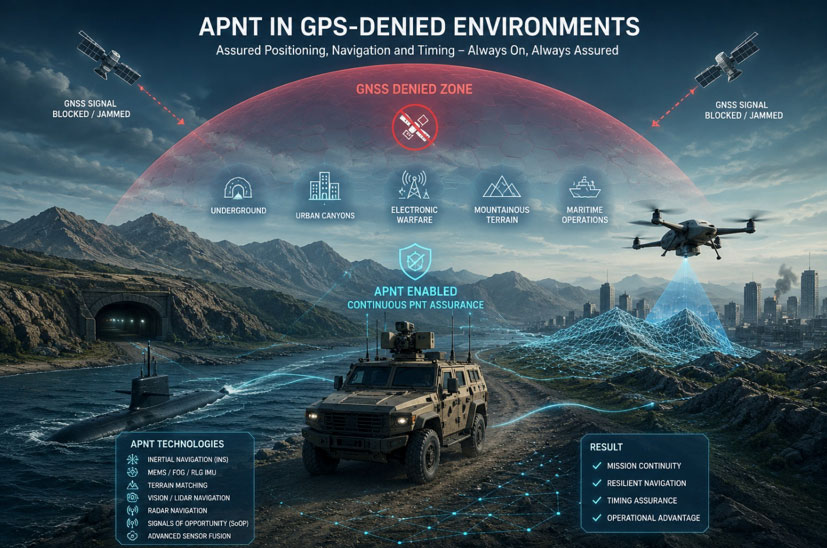
Examples include:
- Electronic warfare operations
- Naval missions
- Underground facilities
- Dense urban areas
- Tactical military operations
- Autonomous drone missions
- Arctic environments
- Space operations
In these scenarios, APNT enables platforms to continue operating safely and accurately even without continuous GNSS availability.
Applications of APNT
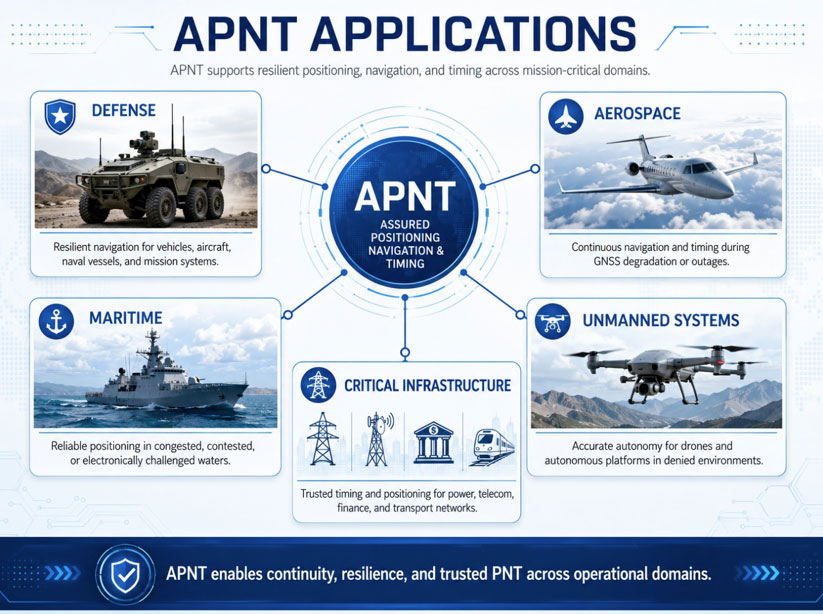
APNT is becoming increasingly important across multiple industries.
Defense
Military vehicles, aircraft, naval vessels, missile systems, and unmanned platforms require resilient navigation to maintain operational effectiveness in contested environments.
Aerospace
Aircraft benefit from continuous navigation during GNSS outages while maintaining high levels of safety and precision.
Maritime
Ships operating in congested ports or electronic warfare environments require reliable positioning independent of satellite availability.
Unmanned Systems
Drones and autonomous vehicles rely on APNT to maintain accurate navigation during signal degradation or intentional interference.
Critical Infrastructure
Power grids, telecommunications, financial systems, and transportation networks require resilient timing information for continuous operation.
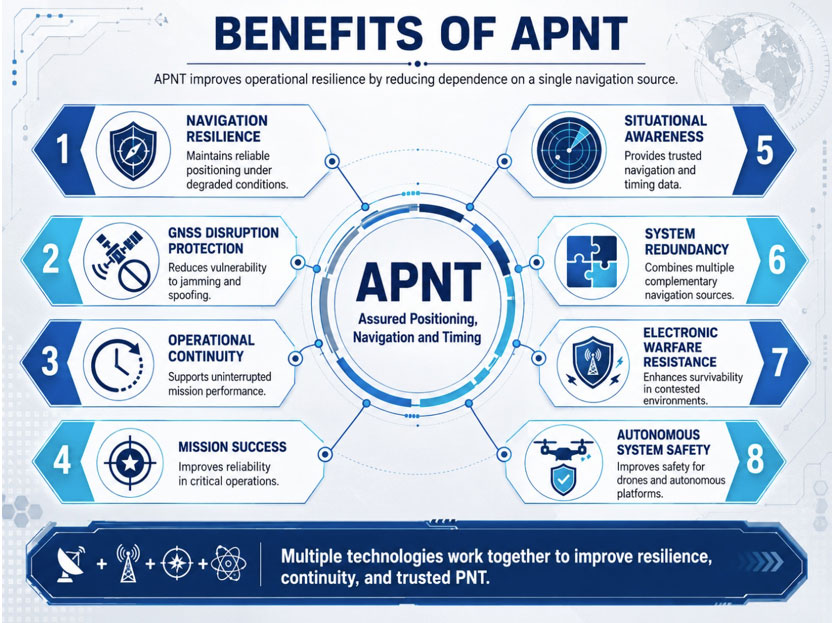
Benefits of APNT
Organizations implementing APNT solutions gain several important advantages:
- Increased navigation resilience
- Protection against GNSS disruption
- Improved operational continuity
- Higher mission success rates
- Enhanced situational awareness
- Greater system redundancy
- Reduced vulnerability to electronic warfare
- Improved safety for autonomous systems
The Future of Navigation
As electronic warfare capabilities continue to evolve, resilient navigation technologies are becoming a strategic necessity rather than an optional enhancement.
Future navigation architectures will increasingly rely on sensor fusion, artificial intelligence, multi-domain navigation, and integrated positioning technologies capable of maintaining accurate navigation under all operational conditions.
APNT represents a critical component of this future by ensuring trusted Positioning, Navigation, and Timing information regardless of environmental challenges.
Conclusion
Reliable Positioning, Navigation, and Timing have become essential for modern defense, aerospace, maritime, and autonomous systems. While GNSS remains an important component of navigation, resilient operations increasingly require solutions that continue functioning when satellite signals are unavailable or compromised.
By integrating inertial navigation, advanced sensors, anti-jamming technologies, and multiple complementary navigation sources, APNT provides the reliability needed for today’s complex operational environments.
Organizations investing in APNT are better prepared to maintain mission effectiveness, enhance operational resilience, and navigate confidently in contested or GPS-denied environments.